

Biogas faces a market reality check as wind and solar dominate renewables
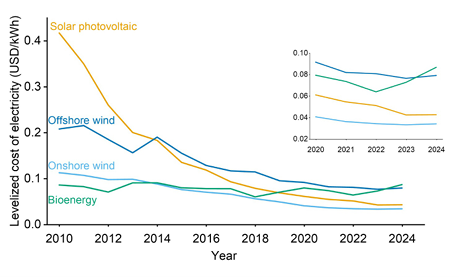
Global weighted-average LCOE of renewable power technologies, 2010–2024. Data source: IRENA (2025), Renewable Power Generation Costs in 2024 (IRENA, 2025).
GA, UNITED STATES, September 13, 2026 /EINPresswire.com/ -- In 2024, wind and solar accounted for 96.6% of newly installed global renewable electricity capacity, while biogas—primarily used for power generation—contributed just 0.5%. A new analysis reveals two structural challenges constraining biogas expansion: its high and stagnant costs, and feedstock limitations that risk turning biogas production into a competitor for agricultural land. The authors argue that biogas should be strategically reassessed not as a primary energy source, but as a niche solution for seasonal energy storage, grid balancing, waste management, and green chemistry.
Over the past decade, the cost of wind and solar energy has dropped by 70% to 90%, while bioenergy costs have remained virtually unchanged—even rising slightly from 0.086 to 0.087 USD/kWh. In Germany, the 2024 levelized cost of electricity for biogas ranged from 20.2 to 32.5 euro cents/kWh, far exceeding wind (4.3–10.3 euro cents/kWh) and utility‑scale solar photovoltaic (PV) (4.1–6.9 euro cents/kWh). Unlike wind and solar, biogas plants face recurring feedstock costs after construction, and feedstock availability is inherently limited. The International Energy Agency (IEA) estimates that while global biomethane potential is about 730 million tonnes of oil equivalent (Mtoe), only 55 Mtoe can be developed below 10 USD/MMBtu (million British thermal units). Given these economic and resource realities, a fundamental reassessment of biogas deployment strategies is urgently needed.
The perspective article, published in 2026 in ENGINEERING Environment (Volume 20, Issue 12), was authored by Mingze Shi and Xinmin Zhan at the University of Galway (Ireland), along with an international team from Spain, the Netherlands, the United Kingdom, China, and Japan.
The analysis highlights a stark economic disadvantage for biogas. Unlike the standardised, mass‑manufactured technologies behind wind turbines and solar panels, biogas systems are site‑specific and less scalable, limiting their ability to benefit from economies of scale. More critically, biodigester installation accounts for only 20% to 40% of total biomethane production costs, with feedstock procurement, processing, and plant operations making up the remainder—a recurring cost burden that wind and solar simply do not carry.
The feedstock challenge is equally daunting. Germany, a biogas leader, illustrates the land‑use tension: in 2024, energy crops for biogas occupied 1.35 million hectares (ha), with maize covering nearly two‑thirds of that area. Each additional billion cubic metres (bcm) of crop‑based biomethane would require roughly 0.17 to 0.25 million ha of agricultural land, risking direct competition between fuel and food production. Countries including Germany, Italy, and Austria have already shifted feedstocks from organic waste to purpose‑grown energy crops to keep plants economically viable—a trend that only intensifies this conflict.
The authors also point to a troubling subsidy dynamic. From 2021 to 2023, European Union (EU) fossil‑fuel subsidies surged while renewable‑energy subsidies declined from €83 billion to €61 billion. Biogas projects often depend on a package of multiple support mechanisms simultaneously. A recent Irish case study showed that a 40 GWh/year anaerobic digestion plant producing biomethane from cattle slurry and grass silage required, beyond biomethane certificates and capital grants, an additional farm subsidy of €893 per ha to remain viable.
"The numbers are clear: biogas cannot compete with wind and solar on cost, and it never will if we keep treating it as a primary electricity source," the authors said. "That doesn't mean we should abandon biogas—it means we need to be smarter about where and how we deploy it. The real value of biogas lies not in competing head‑to‑head with renewables on price, but in providing grid flexibility, managing organic waste, and enabling green chemistry. We need to stop subsidising biogas as if it were wind power and start funding it for what it actually does well."
The authors advocate for a strategic, case‑by‑case approach to biogas development. Rather than pursuing ambitious expansion targets that rely on heavy subsidies, policymakers should prioritise projects that deliver unique, non‑substitutable benefits. These include leveraging existing gas infrastructure for seasonal energy storage and rapid load balancing—capabilities that current battery technologies cannot yet match economically. Biogas also offers critical environmental co‑benefits: anaerobic digestion can inactivate over 99% of major pathogens in livestock manure, and fully utilising manure for biogas could mitigate 1,000 MtCO₂‑equivalent of agricultural greenhouse gas (GHG) emissions annually. Additionally, biogas can support methane‑based biorefineries for producing green chemicals. Without breakthroughs in feedstock availability, however, poorly planned biogas expansion risks becoming a financial liability rather than a climate solution.
References
DOI
10.1007/s11783-026-2292-8
Original Source URL
https://doi.org/10.1007/s11783-026-2292-8
Funding information
This work is supported by the Science Foundation Ireland (No. 22/EPSRC/3856) and China Scholarship Council (No. 202306790005).
Lucy Wang
BioDesign Research
email us here
Legal Disclaimer:
EIN Presswire provides this news content "as is" without warranty of any kind. We do not accept any responsibility or liability for the accuracy, content, images, videos, licenses, completeness, legality, or reliability of the information contained in this article. If you have any complaints or copyright issues related to this article, kindly contact the author above.
