

Digital Printing Packaging Market Expands at 10.6% CAGR, Crossing $98.8 Billion by 2035 from $36.08 Billion in 2025
Digital Printing Packaging Market
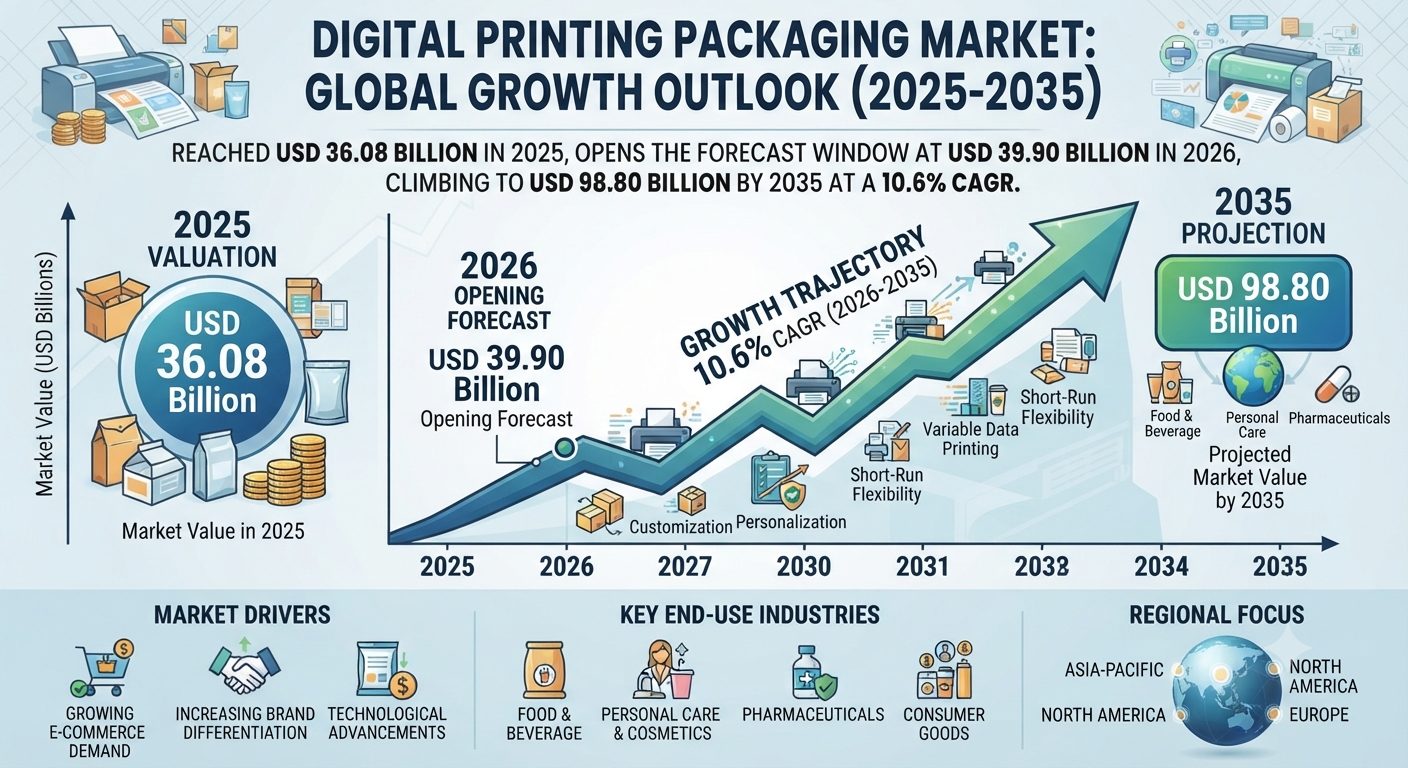
According to Market Research Future (MRFR), the digital printing packaging market was valued at approximately USD 36.08 billion in 2025 and is projected to reach USD 98.80 billion by 2035, representing a 10.6% CAGR from 2026 to 2035.
What Is Digital Printing Packaging?
Digital printing packaging refers to the use of digital printing technologies to produce graphics, text, variable information, and other visual elements directly onto packaging materials. The technology can be applied to labels, flexible packaging, corrugated packaging, folding cartons, bottles, jars, and other formats.
Major technologies include inkjet printing, liquid toner electrophotography, nano-graphic printing, and other digital printing systems. These technologies provide packaging converters with greater flexibility compared with traditional analog processes.
One of the biggest advantages is the ability to change artwork without creating new printing plates or cylinders. As a result, manufacturers can economically produce smaller batches, customized designs, seasonal editions, regional versions, and personalized packaging.
Get Sample @ https://www.marketresearchfuture.com/sample_request/2782
Market Growth Drivers
Rising Demand for Customized Packaging
Personalization has become an important strategy for consumer brands. Companies increasingly use packaging to differentiate products, communicate with customers, and create memorable purchasing experiences.
Digital printing allows manufacturers to change images, text, colors, promotional messages, and other elements from one package to the next. This capability supports personalized campaigns, limited-edition products, regional packaging, and targeted marketing.
The growing number of product SKUs is another factor supporting demand. As brands introduce more product variants, average production runs can become shorter, making digital printing increasingly attractive.
Expansion of E-Commerce
The rapid development of e-commerce is creating new opportunities for digitally printed packaging. Shipping boxes, cartons, labels, and other packaging components can be customized for different campaigns, customers, regions, and product launches.
Digital printing enables brands to turn packaging into an additional marketing channel. Customized shipping boxes and digitally printed labels can strengthen brand visibility while also supporting fast changes in artwork.
MRFR identifies e-commerce parcel and shipper personalization as an important growth factor for the industry.
Growing Focus on Sustainable Packaging
Sustainability is becoming increasingly important for packaging manufacturers and brand owners. Companies are seeking materials and production processes that can reduce waste and support recyclable packaging designs.
Digital printing can contribute to waste reduction by eliminating or reducing plate-making and setup requirements, particularly for short production runs. It can also make it easier for converters to produce only the quantity required, potentially reducing excess inventory and obsolete packaging.
At the same time, the industry is developing aqueous, UV-cured, latex, resin-based, and other ink technologies designed for different packaging applications and regulatory requirements.
Growth of Short-Run Production
Traditional printing technologies remain highly competitive for very large production volumes. However, digital printing becomes particularly attractive when manufacturers need shorter runs and frequent artwork changes.
The ability to move quickly from one design to another without extensive make-ready processes can reduce production complexity and improve turnaround times.
This is particularly valuable for industries such as food and beverages, cosmetics, pharmaceuticals, and consumer goods, where packaging designs can change frequently.
Key Technology Trends
Inkjet Printing
Inkjet technology is one of the most important growth areas in digital packaging. Advances in printhead technology, printing speeds, drying systems, color management, and ink chemistry are improving the performance of digital inkjet systems.
According to MRFR, inkjet technology is forecast to record a 15.2% CAGR through 2035, supported by improvements in reliability and aqueous ink technologies.
Electrophotography
Liquid toner electrophotography remains important, particularly in applications requiring accurate color reproduction and high-quality graphics.
MRFR reports that liquid toner electrophotography accounted for 37.4% of the market in 2025, supported by demand for high-quality premium label applications.
Variable Data Printing
Variable data printing allows individual packages to contain different information without stopping the production process. This capability is particularly useful for serialization, traceability, promotional campaigns, QR codes, barcodes, and personalized packaging.
The technology is becoming increasingly relevant to pharmaceutical and regulated industries, where unique identification and traceability are important requirements.
Buy Now @ https://www.marketresearchfuture.com/checkout?currency=one_user-USD&report_id=2782
Product Segmentation
The digital printing packaging market covers several major packaging formats.
Labels
Labels represent one of the largest applications for digital printing. The technology supports high-quality graphics, short runs, variable information, and frequent artwork changes.
MRFR estimates that labels accounted for 32.8% of market revenue in 2025.
Flexible Packaging
Flexible packaging includes pouches, films, wraps, and other lightweight packaging formats. Demand is being supported by convenience-oriented products, portion packaging, resealable formats, and consumer goods applications.
The flexible packaging segment is projected by MRFR to grow at a 13.7% CAGR through 2035.
Corrugated Packaging
Corrugated packaging is benefiting from e-commerce and the growing importance of customized shipping boxes. Digital printing can allow corrugated manufacturers to produce highly customized graphics without the setup requirements associated with some traditional processes.
Folding Cartons
Folding cartons are widely used in food, pharmaceuticals, cosmetics, electronics, and consumer goods. Digital printing enables manufacturers to create multiple versions of carton artwork while maintaining efficient production for shorter runs.
End-Use Industries
Digital printing packaging serves a broad range of industries.
Food and beverage companies use digital printing for labels, pouches, cartons, cans, and promotional packaging. Food represented 28.1% of market revenue in 2025, according to MRFR.
The pharmaceutical sector is another important application because digital printing can support serialization, variable data, product identification, and track-and-trace requirements.
The personal care and cosmetics industry benefits from high-quality graphics and customized packaging, particularly for premium and limited-edition products.
Digital packaging also has applications in electronics, automotive, consumer goods, and industrial products, where labels and cartons may require variable information and brand-specific designs.
Regional Market Outlook
North America currently represents a major regional market. MRFR estimates that the region accounted for approximately 30.0% of 2025 market revenue, supported by established packaging converter networks and early adoption of digital technologies.
Europe is another significant market, with sustainability regulations and packaging redesign requirements influencing investment in digital printing technologies.
Meanwhile, Asia-Pacific is expected to be the fastest-growing regional market, with MRFR projecting a 15.6% CAGR through 2035. Growing manufacturing capacity, expanding consumer markets, increasing e-commerce activity, and rising adoption of customized packaging are supporting the region's development.
India, China, Vietnam, and Indonesia are particularly interesting markets because packaging production is expanding alongside consumer demand and industrial development.
Sustainability and Digital Packaging
Sustainability will remain one of the defining themes of the packaging industry.
Digital printing can help address sustainability objectives through more efficient short-run production, reduced setup waste, and improved inventory management. In addition, the development of water-based and other specialized ink systems is expanding the range of applications available to packaging converters.
The transition toward recyclable and mono-material packaging is also encouraging manufacturers to rethink substrates, coatings, inks, and printing processes.
However, digital printing should not automatically be considered sustainable in every application. The overall environmental impact depends on the substrate, ink chemistry, energy consumption, production volume, finishing process, and end-of-life recyclability.
Read More @ https://www.marketresearchfuture.com/reports/digital-printing-packaging-market-2782
Challenges Facing the Market
Despite strong growth prospects, the digital printing packaging industry faces several challenges.
High equipment costs can make digital presses difficult to justify for smaller converters. According to MRFR, single-pass inkjet systems with integrated finishing capabilities can require significant capital investment.
Ink and consumable costs can also affect operating economics, particularly when digital printing is compared with conventional processes for very long production runs.
Another challenge is regulatory compliance, especially for packaging used in direct food-contact applications. Ink migration, substrate compatibility, and regional regulatory requirements must be carefully evaluated.
The industry also faces a shortage of skilled professionals with expertise in digital press operation, color management, workflow automation, and data-driven production.
Competitive Landscape
The digital printing packaging market includes major technology and printing equipment companies such as HP Inc., Canon Inc., Xerox Holdings, Domino Printing Sciences, Xeikon, and Landa Digital Printing, among others.
Competition is increasingly focused on printing speed, image quality, automation, workflow integration, substrate compatibility, ink performance, and total operating costs.
Manufacturers are also developing hybrid solutions that combine analog and digital printing. Such systems can allow converters to use conventional printing for long-run elements while using digital technology for variable or customized content.
Browse More Reports:
Paper Bags Packaging Market https://www.marketresearchfuture.com/reports/paper-bags-packaging-market-2039
Corrugated Boxes Market https://www.marketresearchfuture.com/reports/corrugated-boxes-market-4179
Low E Glass Market https://www.marketresearchfuture.com/reports/low-e-glass-market-12286
Advanced Packaging Market https://www.marketresearchfuture.com/reports/advanced-packaging-market-12461
Pet Food Packaging Market https://www.marketresearchfuture.com/reports/pet-food-packaging-market-1248
Glass Packaging Market https://www.marketresearchfuture.com/reports/glass-packaging-market-1258
Market Research Future
Market Research Future
+1 855-661-4441
email us here
Legal Disclaimer:
EIN Presswire provides this news content "as is" without warranty of any kind. We do not accept any responsibility or liability for the accuracy, content, images, videos, licenses, completeness, legality, or reliability of the information contained in this article. If you have any complaints or copyright issues related to this article, kindly contact the author above.
